
Co-browsing: when seeing the customer's screen solves it in minutes
Learn when co-browsing in customer service solves problems text can't, and how it cuts back-and-forth in conversations that keep stalling.
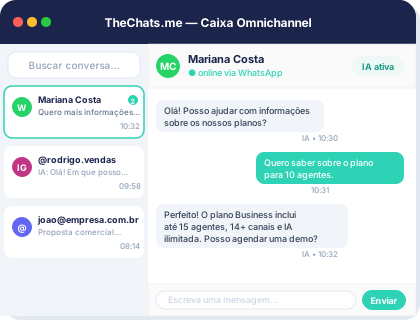
Some conversations stall not because the agent doesn’t know the answer, but because nobody can describe the problem in words. The customer says “the button isn’t showing up,” the agent asks “which button, on which screen, after which click” — and ten messages later it’s still unclear what’s actually in front of the person who needs help. In cases like this, seeing the screen solves what a screenshot and a description never would.
The kind of problem only seeing can solve
Not every conversation needs co-browsing. Most questions — price, timeline, availability — resolve fine over text, and forcing assisted browsing into those cases wastes everyone’s time. Co-browsing pays off when the problem is visual or depends on context the customer can’t quite name:
- A form that gets stuck on one specific field
- A checkout error that only happens with a particular combination of options
- Confusion about “where” a feature lives inside a complex dashboard
- A customer describing the issue one way while the agent understands it completely differently
In these scenarios, every text message spent clarifying what’s happening is a wasted round. Co-browsing and session recording in the webchat exist precisely to cut that cycle short: the agent sees the same screen the customer sees, in real time, without asking them to install anything or share their screen outside the chat.
The cost of not having that option
Without assisted browsing, the default pattern is asking for a screenshot, then another one, then “send a video of your screen,” while the customer loses patience and the agent pieces together an incomplete puzzle. In some cases the team simply gives up trying to understand the problem over text and books a call instead — which pushes the customer to another channel, breaks the conversation’s context, and adds one more step between the problem and the fix.
Every round of “send a screenshot” is time the customer spends proving the problem exists, not getting it solved. Co-browsing flips that: whoever knows how to fix it is already looking at what needs fixing.
The less obvious side effect shows up in SLA metrics: a conversation that should take three messages turns into twenty, and time-to-resolution spikes even though the agent responded quickly from the start. The bottleneck was never response speed — it was the lack of visibility into what was happening on the other end.
How it works inside the webchat
Co-browsing is part of TheChats.me’s live chat widget, alongside conversation history, document and image sharing, and session recording. It isn’t a separate tool the customer has to download or authorize outside the normal flow — assisted browsing happens inside the same conversation window they’re already using, respecting the built-in GDPR/LGPD consent banner in the widget.
That matters for both sides. For the agent, it means not having to leave the unified inbox to open a separate screen-sharing tool. For the customer, it means not having to decide whether to trust another link or another app in the middle of a conversation that already started as text.
When to escalate to co-browsing mid-conversation
It helps to have a simple rule for deciding when to switch modes within the same conversation:
- After the second failed attempt to describe the problem in text
- When the customer uses phrases like “I can’t really explain it, but…” or “just look at what happens”
- In multi-step flows, like onboarding or checkout, where a small error at any step blocks everything after it
Teams that wait too long to escalate end up spending more time decoding text than they would have spent just looking at the screen. The productivity gain here isn’t making the agent work faster — it’s avoiding the guessing work that eats time without producing a solution.
What changes in your quality reports
Conversations resolved with visual support tend to close faster and with fewer messages exchanged, which shows up in volume, conversion, SLA, and quality reports. That doesn’t mean tracking “how many times we used co-browsing” as a goal — it means teams that adopt this well typically see average resolution time drop in conversations that used to get stuck in back-and-forth description.
If your team is still solving visual problems with screenshots and patience, see how TheChats.me’s webchat brings co-browsing, history, and consent into the same widget, or schedule a demo to see assisted browsing work with a real case from your operation.